

Talks & Extras
Find Out More
Conference Talks and Discussions
Following are some of the talks presented and results of discussions at the FQXi 2009 International Conference. All presentations are copyrighted by the authors and may not be copied or distributed without prior written permission.
Welcome Talks:
Paul Davies: Teleology without teleology

Alan Guth: Thorny problems in cosmology
Yakir Aharanov: A new approach to quantum mechanics
Jos Uffink: Entanglement entropy and utility
Frank Wilczek: Particle Physics
Scott Aaronson: How much information is in a quantum state?
Fotini Markopoulou: Quantum gravity
Julian Barbour: The minimal geometrical ontology for a fundamental theory
Peter Byrne: The many worlds of Hugh Everett III
Time And Quantum Gravity:
Claus Kiefer: Does time exist in quantum gravity?
Rodolfo Gambini: The issue of time in totally constrained systems and quantum gravity
Ettore Minguzzi: Time and causality in general relativity
Andreas Albrecht: Challenges for a quantum theory of the universe: The clock ambiguity and the Born rule crisis
Cosmology:
Fred Adams: Stars in other universes
Laura Mersini-Houghton: An aether of time
Anthony Aguirre: Is the Universe Infinite?
Olaf Dreyer: Internal relativity and early universe cosmology
Martin Bojowald: Quantum gravity and the beginning of the universe
Steven Gratton: Path integral for volume-weighted eternal inflation
Eduardo Guendelman: Developments in wormhole theory, child universe theory and their implications for cosmology and quantum gravity
Paulo Vargas Moniz: ‘Observational’ supersymmetric quantum cosmology
Quantum Gravity I:
Steven Savitt: What is a Block Universe?
Glenn Starkman: In praise of the inverse square law
Maulik Parikh: The mysterious thermodynamic origin of classical gravity
Steven Weinstein: Gauge potentials and gravitation
Xiao-Gang Wen: Tensor network approach to emergence of gauge theory
Tevian Dray: Octonions and Fermions
A. Garrett Lisi: The geometric structure of the standard model and gravity
Daniele Oriti: Group field theories – Microscopic discrete models of quantum spacetime
Florian Girelli: Are there any relationships between non-commutative geometry and (loop/spinfoam) quantum gravity?
Quantum Gravity II:
Bernard Carr: Interlinking black holes, quantum theory, time and many worlds
Tejinder Pal Singh: Quantum measurement and quantum gravity: many worlds or collapse of the wave-function?
Sabine Hossenfelder: Phenomenological quantum gravity
Dmitry Budker: Table-top experimental tests of fundamental symmetries of nature
Mikhail Kozlov: Atomic and molecular spectra as probes for fundamental constants
Dean Rickles: The mathodology of string theory
Quantum Mechanics:
Bob Coecke: The logic of non-local quantum spacetime
Dan Browne: Bell inequalities and computational correlations
Howard Barnum: Information processing protocols and primitives and the structure of physical theories
Caslav Brukner: Theories of systems with limited information content – Quantum theory and beyond
Joy Christian: Disproof of Bell’s theorem
Max Tegmark: What do the dimensionless constants tell us?
Alonso Botero: When is it appropriate to describe a quantum mechanical system using a point in phase space?
Jeff Tollaksen: A new approach to quantum mechanics
Discussion: What is Possible?
Attendees devoted much time to discussing the ultimate future of physics. The organizers asked them, what might possibly happen in the next 10 years? What about the next 1,000 years? Speculation commenced on new ideas, new technology, and new phenomena. It was even kindly suggested that FQXi might continue into the next millenium (although, in the form of a “world-dominating machine society”).
For the full list of suggested possibilities, click here.
The organizers then asked the attendees, how likely was each possibility? How interesting was it, if it should occur? How important an event would it be? The answers: In 10 years, it was judged most likely that Moore’s law will fail, and least likely that the multiverse will be definitely observed. It will be most interesting and most important if deviations from quantum mechanics are found. In 1,000 years, it was judged most likely that the Second Law of Thermodynamics will still hold true, but least likely that we will pay ready visits to other universes. It will be most interesting if we have made contact with extra-terrestial intelligence, but most important if quantum mechanics still holds true.
For more rankings details, click here.
The statistics collected to make the rankings suggest a curious trend, shown by the following scatter plots. Here, we numbered each possibility according to place in the three rankings lists (so, 14th highest ranking is numbered 14, etc.).
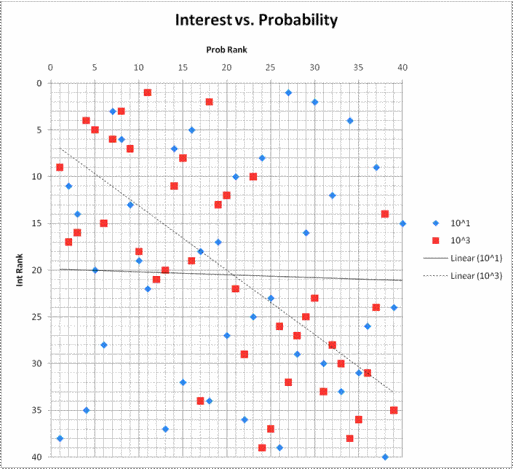
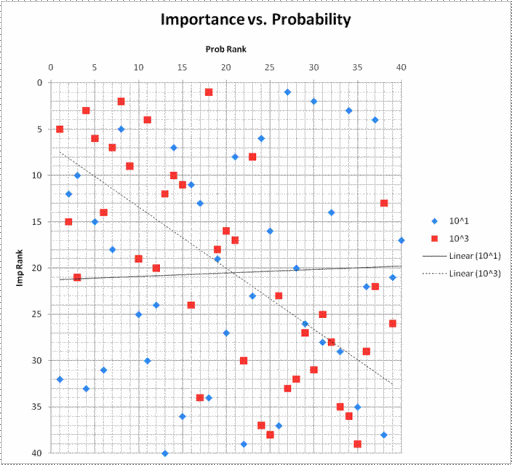
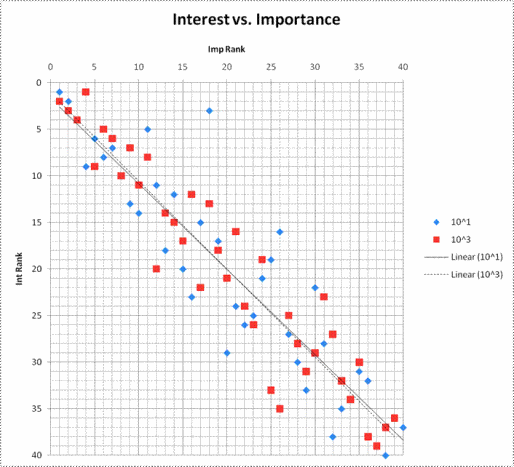
There appears to be a correlation between what the attendees judged most interesting and most important; but no reliable correlation between these and what is most likely. This result speaks to the idea at the heart of FQXi’s mission: the safest research bet is not always what’s most interesting and important.

QSpace Latest
Article: Living Reviews: The Wikipedia of Science
Journal papers that can be constantly updated allow researchers to better tell the never-ending story of science.